Cv Valve Flow Coefficient Calculator for Water, Viscous Liquid, and Gas
Determining the correct flow capacity of a valve is a critical step in system design and sizing. This valve flow coefficient (Cv) calculator helps estimate how much liquid or gas can pass through a valve based on operating conditions such as fluid type, temperature, and inlet and outlet pressures.
By accounting for absolute inlet and outlet pressure, this calculator provides a practical way to evaluate valve performance before installation or replacement.
Valve Cv Calculator for Water
Valve Cv Calculator for Viscous Liquid
Valve Cv Calculator for Gas
Understanding Valve Flow Capacity
Valve flow capacity describes the volume of fluid a valve can pass under specific conditions. This capacity is commonly represented by the flow coefficient, known as Cv.
The Cv value allows engineers and technicians to compare valves of different sizes, designs, and manufacturers. Using a Cv calculator simplifies this process and helps ensure the selected valve can handle the required flow without excessive pressure loss.
Online Cv Flow Calculator
Manual Cv calculations can become complex, especially when working with different fluids or gases. Our online Cv calculator removes the guesswork by handling the math for you.
Because liquid and gas flow behave differently, separate formulas are used depending on the application. The sections below explain how Cv is calculated for each case.
Converting Between Cv and Kv

Valve flow capacity can be expressed using either imperial or metric units. In imperial systems, capacity is measured using Cv, which represents the number of U.S. gallons per minute that flow through a valve with a 1 psi pressure drop.
In metric systems, the equivalent value is Kv. The two coefficients are related by the following conversions:
Kv = 0.857 × Cv
Cv = 1.165 × Kv
These values make it easier to compare valve performance across different standards and regions.
How Cv Is Calculated
The Cv calculation depends on the medium flowing through the valve. Below are the most common formulas used for water, other liquids, and gases.
Cv Formula for Water
For water flow applications, Cv can be calculated using:
Cv = Q / √(P1 − P2)
Where:
- Cv = valve flow coefficient
- Q = flow rate (GPM)
- P1 = upstream pressure
- P2 = downstream pressure
Cv Calculation for Liquids
Liquid flow calculations may vary depending on whether the flow is laminar or turbulent.
Turbulent flow:
FpCv = (Q / (N1 × Fr)) × √(SG / (P1 − P2))
Laminar flow:
FpCv = (1 / Fs) × ((Q × U) / (N10 × (P1 − P2)))2/3
The appropriate equation is selected based on the Cv ratio:
- If Cv Ratio < 0.46 → use laminar flow equation
- If Cv Ratio ≥ 0.46 → use turbulent flow equation
Variable definitions:
- Q = flow rate (GPM)
- U = viscosity (centipoise)
- SG = specific gravity (relative to water at 60°F)
- P1 / P2 = upstream and downstream pressure (PSI)
- N1 = 1.0 (unit constant)
- N10 = 52.3 (unit constant)
- Fp = piping correction factor (typically 1.0)
- Fr = Reynolds number factor (typically 1.0)
- Fs = valve style factor (commonly 1.05 for plug valves)
Cv Formula for Gas
Gas flow requires a different approach due to compressibility. The Cv formula for gas is:
Cv = Q / (16.05 × √((P1² − P2²) / (SG × (T + 460))))
Where:
- Cv = valve flow coefficient
- Q = gas flow rate (SCFM)
- P1 / P2 = upstream and downstream pressure (PSI)
- SG = gas specific gravity (relative to air)
- T = gas temperature (°F)
Common Valve Types
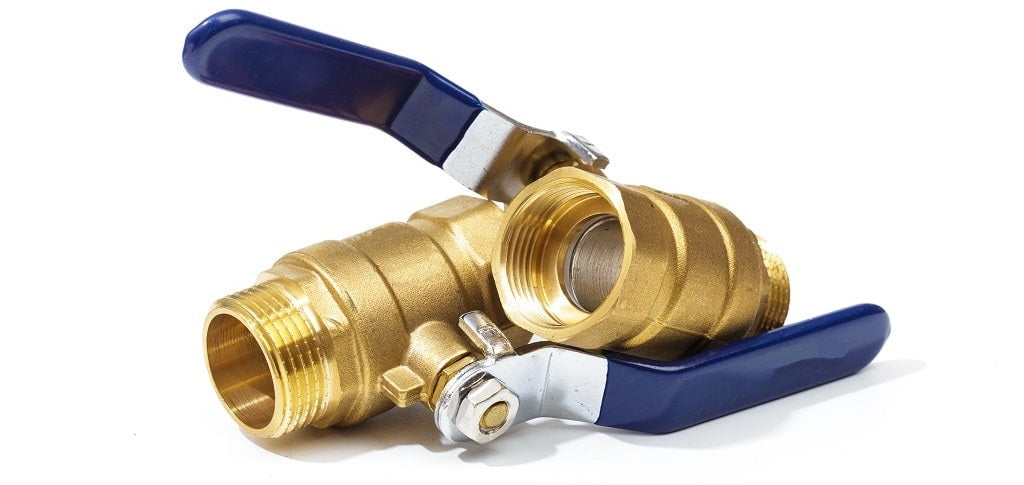
Once you’ve determined the required Cv, selecting the appropriate valve design is the next step. Below are some commonly used valve types.
Ball Valves
Ball valves provide straight-through flow with minimal pressure drop. They are well-suited for isolation applications and are available in a wide range of sizes, materials, and connection types.
Globe Valves
Globe valves are designed for flow regulation rather than isolation. Their internal flow path creates higher pressure loss, making them ideal for throttling applications where precise control is required.
Butterfly Valves
Butterfly valves offer compact construction, low operating torque, and fast actuation. They are commonly used for low-pressure flow control and isolation.
If you need help calculating Cv or selecting the right valve for your application, our team can assist with both sizing and product selection. Contact our specialists to ensure your system operates efficiently and reliably.